
Best Time to Visit the UAE: A Month-by-Month Guide
The best time to visit Dubai and the UAE, month by month: temperatures, crowds, prices, Ramadan, festivals and when the desert season starts.

How to get mobile data in the UAE: tourist SIMs and eSIMs from e& and du, travel eSIM apps, roaming, free Wi-Fi, registration rules and which calling apps work.
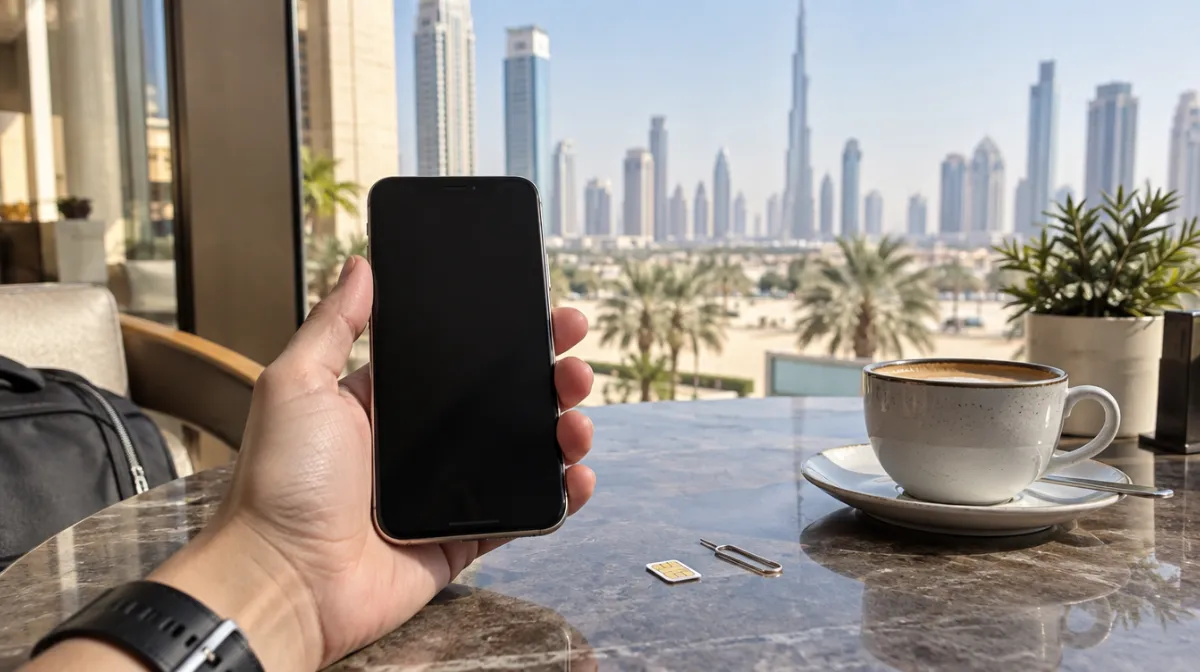
Mobile data makes a UAE trip far easier: maps, ride-hailing, restaurant bookings, e-tickets and translation all depend on it. The good news is that coverage is excellent across the cities and main roads, and getting connected takes minutes. The main decision is whether to buy a local tourist line on arrival or set up a travel eSIM before you fly.
| Option | Best for | Local number | Set up |
|---|---|---|---|
| Local tourist SIM or eSIM (e&, du, Virgin Mobile) | Longer stays, calls to local numbers | Yes | At the airport, in shops or in the operator’s app, with your passport |
| Travel eSIM app | Short trips, data only | Usually no | Online, before you fly |
| Roaming | Very short trips, convenience | Your own | Nothing, but check the price |
| Wi-Fi only | Light users | No | Hotels, malls, cafés and the metro |
The UAE’s operators, e& (formerly Etisalat) and du, plus Virgin Mobile on du’s network, all sell tourist packages that bundle data, local minutes and sometimes international minutes for a set number of days. e& calls its product the Visitor Line; du sells tourist plans under its own name. Both networks offer fast 4G and 5G coverage in the cities.
International eSIM providers sell UAE data plans that you install before departure, so you land connected and skip the airport queues. They’re usually data-only, so you won’t get a local number, but that rarely matters for tourists: ride-hailing apps, restaurant bookings and most tickets work with your home number or email.
Check three things before you buy: that your phone supports eSIM, that it’s not locked to your home carrier, and which UAE network the plan uses.
Roaming is the simplest option but often the most expensive, as many home plans treat the UAE as a premium destination. If you roam, buy your operator’s travel add-on before you leave and switch off data roaming for anything you don’t need. Keeping your home SIM active in a dual-SIM phone is useful for bank security codes by text, even if you use another line for data.
Free Wi-Fi is widespread: hotels, malls, many cafés and restaurants, the Dubai Metro and airports all offer it, often after a short registration. It’s fine for light use, but you’ll still want data for maps and ride-hailing when you’re out and about.
Messaging on WhatsApp and similar apps works normally. However, voice and video calls on some apps, including WhatsApp, have long been restricted in the UAE, while a few other calling apps are permitted and operators sell internet-calling plans for approved services. What works can change, so:
Maps and ride-hailing use surprisingly little data; video and uploading photos use a lot. Download offline maps and entertainment on hotel Wi-Fi to stretch your allowance.
Factor connectivity into your daily budget alongside transport and food.
Yes. Operator counters in the arrivals halls sell tourist SIMs and eSIMs. Bring your passport for registration.
Messaging does. WhatsApp voice and video calls have long been restricted, so use ordinary calls or a permitted calling app instead.
It’s more convenient if your phone supports it, because you can set it up before you fly and keep your home SIM in place. A physical SIM works in any unlocked phone.

Every article is edited by a human and checked against our editorial policy. Spotted a mistake? Tell us.
The best time to visit Dubai and the UAE, month by month: temperatures, crowds, prices, Ramadan, festivals and when the desert season starts.
Dubai or Abu Dhabi? An honest comparison of atmosphere, attractions, beaches, culture, food, costs and families, plus how to combine both in one trip.
How UAE tourist visas work: visa-free entry and visa on arrival, applying in advance, passport validity, overstays and the official sources to check.